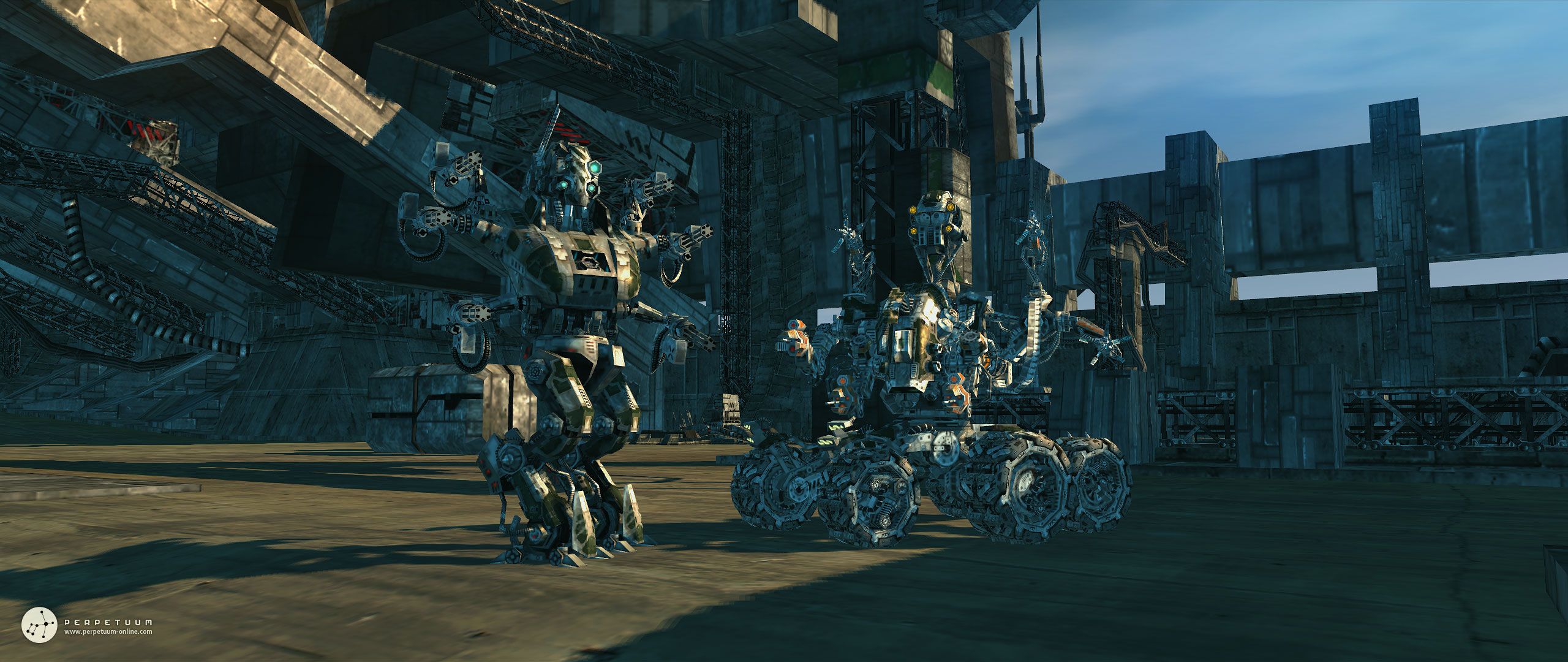
The time has finally come to announce the opening of the floodgates - PBS will roll out to our temporary test server and you're all welcome to rip it to shreds during the following few weeks.

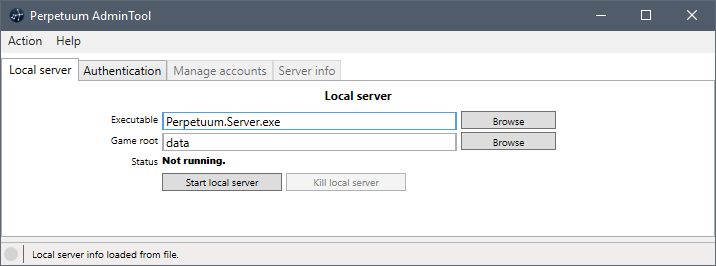
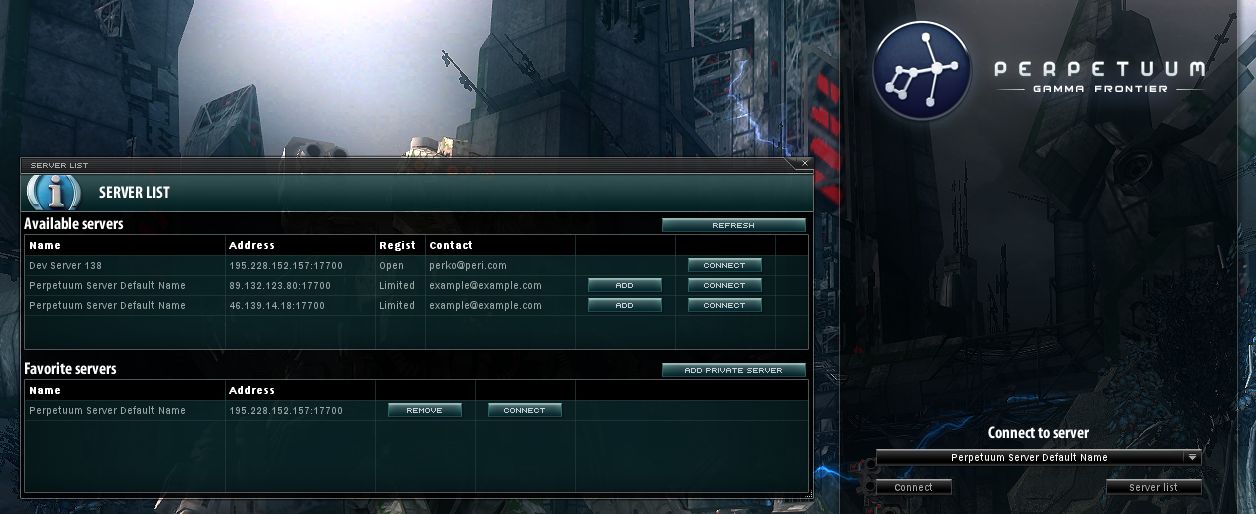
The server will open on Friday, 12:00 CEST, and you can already start preloading the test-client here. An important technical note I'd like to make: There's been a number of considerable changes in architecture, so it's important that you make this a separate installation! It is not recommended to install this over an existing Perpetuum installation or to try and skip ahead in preloading by using an existing datafile - this test client will only work with the test server! Other than that, it's the same old download-run-watch-progress-bar-login routine we all know so dreadfully well.

Now, this isn't the only thing to keep in mind. The test server, being somewhat different from the usual environment, needs a few things to be explained or taken note of:

  • If you have a valid, paid account when the test server opens up, your account will be valid for the test-server as well. On the other hand, we will not perform continuous syncing; if you're late for the party, you won't get in. (That doesn't mean we won't do syncing later, but you have to have your best puppy-eyes in store.)
  • The test server is subject to the same EULA/COC as the live one - be civil, even if something's broken (and oh yes, there will be blood).
  • PVP on the test server should be strictly consensual; we won't limit your options via technical restrictions, but assuming that you're on the server to test, breaking someone else's gameplay won't help any of us, and we might revoke your access if you keep continually disturbing other players.
  • For obvious reasons, some things will run in "cheat mode": The market will seed everything for low prices, you will get large amounts of EP and NIC, time-dependent processes will be sped up to minutes instead of hours, and robots will get automatically reimbursed after they've been shot. Of course this makes economic balancing difficult, but at the same time we don't want to wait two months for the first base to be built either.
  • The test server will cease operation as soon as we consider testing complete and deploy the patch to the final live server. No data will be migrated back.

There will be a separate forum for the testing server topics here, so please open topics or post opinions there instead of other forums so we don't have to fish all the ideas and death threats together from other forums.

That's all I suppose, happy preloading, testing, and Lord Have Mercy.

Following on the trails of the massive three-part series about structure networks, today we’ll dive into the scary depths of industry and make an attempt at explaining why it was necessary to turn it upside down. Be warned: it’s long and there is some heavy number-crunching ahead, but luckily there is a tl;dr at the end.

Mineral field and geoscanning changes

As mentioned in the first PBS blog, we’re changing the current fixed position mineral fields to random spawns, where the fields won’t get “refilled”, but new fields will appear instead, once the current ones are depleted. The change is first and foremost required due to the new terraformable gamma islands, because fixed mineral fields would interfere with the nature of free terraforming.

However, we’re doing this not only on gamma islands, but on all alpha and beta islands too. The only difference is that on alphas and betas new mineral fields can only spawn on passable terrain, but on gammas they can spawn anywhere on the island, and you will have to terraform your way to them (this is a change since the terraforming blogpost). Our intention with this is to make the process of scanning for minerals more meaningful, maybe even to the point of turning it into a profession in itself, as opposed to the current system where you just need to find and map out all the fixed mineral fields and return to them like they were some kind of candy dispensers.

Now, with the need for constant geoscanning for new fields you may think that it would be a very tedious task with the available tools, and you’re right. That’s why we’re replacing area-based geoscanner charges with brand new directional scanning charges. These will show you the direction to the nearest tile holding the charge-specific mineral, but not the distance. It’s somewhat similar to artifact scanning, but it will require different tactics. Notice I wrote “nearest tile”: it’s equally possible that it will guide you to a tiny residue, or to a tile which is part of a large field. Once you’ve found your spot, you can use the good old tile-based scanner to find out whether you hit the jackpot or not. In the long run, this system will require miners to do a “clean job”, as randomly scattered residual spots will soon make directional scans less and less efficient.

This ties into the generation of new mineral fields: the system periodically checks the overall amount of minerals on each island, and if this gets under a certain threshold value, a new mineral field will be generated in a random spot. However, if the mineral map of an island gets too much fragmented by haphazard mining practices, the spawning of new fields will probably slow down, since the overall mineral amounts will be there, but scattered all around the island in lots of low-yield tiles.

We’re also changing the mining process itself: the current method of storing “mining cycles” in ground tiles will be converted to a more straightforward system. Tiles will hold the exact amount of minerals you can get out of them, so there won’t be a “loss” of minerals when someone with less advanced equipment or extensions mines them; he/she will just simply extract less over time, without wasting any potentially minable minerals during the process.

New minerals, factional redistribution

So far there hasn’t been much difference in the availability and usage of minerals and commodities among the three factions. Of course we’ve tried to make specific minerals more abundant than others, but this was a fragile balance, as the components used for manufacturing didn’t have such separation among the faction technologies. With the coming expansion we’re taking a big step to stir up this uniformity.

Factional differences for raw minerals

Each of the three factions will have one distinct mineral that is representative in their specific technology. For Pelistal this will be Silgium, a brand new minable raw mineral, for Nuimqol it’s Imentium, and for Thelodica it’s Stermonit.

Titan and HDT will have a role as common basic minerals used by all factions, and Titan will be reinstated to Beta, but these two will be still more abundant on Alpha islands.

In the high-end mineral department, Epriton and Noralgis will be accompanied by a new mineral available only on gamma islands. At first this will be used for building higher tier PBS structures, but in the future it will be required for new robots and equipment as well.

Furthermore, faction-specific minable and harvestable minerals will be distributed in a way that each faction will have certain minerals that are not available on their islands, at all. The aim of this system is to stimulate trade and transport between islands, while avoiding monopolies. This is how it looks:

  • Silgium and Triandlus: available on Pelistal and Thelodica islands, but not present on Nuimqol islands
  • Imentium and Helioptris: available on Nuimqol and Pelistal islands, but not present on Thelodica islands
  • Stermonit and Prismocitae (yes, it’s finally harvestable): available on Thelodica and Nuimqol islands, but not present on Pelistal islands

Commodity types and component diversity

Of course if we differentiate raw minerals this way, we also need to do the same for the commodities that they are refined to, and consequently it will be also reflected in the equipment they are used in.

  • Common basic commodities: Titanium, Plasteosine, and 2 new commodities
  • Nuimqol specific: Statichnol, Chollonin, Polynitrocol
  • Thelodica specific: Metachropin, Prilumium, Polynucleit
  • Pelistal specific: Isopropentol, Vitricyl, Phlobotil
  • High-end components I. (epriton based): Briochit, Alligior, Espitium, Hydrobenol
  • High-end components II. (gamma mineral based): 4 new commodities

Commodities will also get categorized by their role in manufacturing. This can be either basic component, offensive/weaponry component, defensive/armor component, or electric/energy component. Besides bringing more immersion into the game, this should also make it easier to remember what components you generally need for a type of module, and it should also help industrialists in specializing in a specific type of equipment. Both faction and type will be displayed on the icon of commodities.

All this juggling with the components has the consequence that pretty much every robot and module will require completely different commodities compared the current setup on the live server. We did this in a way that the final price of things generally shouldn’t be too much different than what you’re used to, but be aware that there will be some changes. There is an intended “trend” too, namely that robots will require slightly more materials than before, and modules slightly less.

Is your head spinning yet? Well we’re not stopping here, it’s time for some Hungarian Maths™!

Recalculating the industry - the new facility point system

One major issue with how the current industry in Perpetuum works is its rather bad scaling: novice manufacturers have a very hard time keeping up with veteran industrialists, and the main reason for this is the tremendous gap between their efficiency. This makes it near impossible for beginners to have at least a small chance at providing goods at competitive prices.

Of course, experienced manufacturers with high-tech facilities and tools should always keep their leading edge, but we’d like to lessen that efficiency gap and at the same time make the entry into the industry a less painful experience.

This is where our newest obsession comes into picture, convergent functions, or the term you’re probably more familiar with: diminishing returns. (I say obsession because it’s something we plan to apply to various other parts of the game in the future as well.)

Simply speaking, we’re turning all the facility-related calculations into the same point based diminishing system like the way armor resistances work for robots. Facility base efficiencies, your related extensions, your faction relation, etc. will all have a point equivalent and the sum of these points will be your final efficiency. Like in the case of armor resistances, this point value can be converted into a percentage value, which will always converge towards 100% efficiency, but it will never reach it. And similarly, the more efficient you are, the more harder it will be to improve on it.

Production point and facility efficiency graphs

The graph on the right should help you understand it better. When accumulating production points (horizontal axis), it’s relatively easy to reach a good efficiency, but it will gradually get harder to really stand out. Factory efficiency for example starts at 150% time and material needs (compared to “perfect” efficiency), and closes to 100% from upwards. The recycling plant’s efficiency starts at 25%, and the more it closes to 100%, the more commodities you will get from items. The money you have to pay at the repair shop begins at 75% and converges to 0%, but will never reach it.

The system makes the current level-classification of facilities obsolete, as their efficiency will be measured in production points from now on. For “fixed” (NPC controlled) alpha and beta terminals this won’t make a real difference, but in the case of gamma islands where you can attach any number of facilities and facility upgrades to the main terminals, it can be any number in between (and over!) the old level equivalents, too. Of course these points will still be displayed in the terminal information windows, so you can easily compare them from anywhere in the world.

CTs and production in the new system

Calibration templates (CTs) deserve their own paragraph here: their efficiency will be also measured in production points, but the hard limit we had at 100% in the old system is completely gone. The point system makes this possible, because as I explained earlier, the overall production points “thrown” into the pipeline can be quite a lot, but your calculated efficiency still won’t ever reach 100%.

Since the limit for improving CTs doesn’t exist anymore, you will be able to combine CTs in the new gamma-only calibration complex (mentioned in the 3rd part of the PBS blog) infinitely. But remember that it’s only production points what you’ll be combining there - the final efficiency in the factory will always boil down to something less than 100%. This also means that there will be a point where combining two CTs will gain you such a small efficiency increase that it won’t be worth to do it any further.

The production point system also has a nice peculiarity: since efficiencies start to get better already at lower point values, it’s enough to have a really good CT to reach satisfactory results even without access to high-level facilities. Similarly, if you have very good industrial extensions, you can get away with mediocre CTs and facilities, and so on. But the important part is that there will always be some room for improvement.

The manufacturing process itself will also change a bit. First off, factories will not just provide a boost to production times, but they will again have their own material efficiency bonuses. Second, the currently separated cycle and quantity in the factory will be merged into one, and CTs will be degraded with every item production cycle. To compensate for this, CTs will degrade much less in these cycles, and we have also boosted the extension that controls the maximum number of manufacturable items in one slot at a time to 10 per level (so 100 at level 10).

There are still a lot of small details I didn’t cover, but this is already getting too long again, and we’ll also happily answer any specific questions in the comments below, should you have any.

But wait, there is more

Still, there are two things that are not directly industry-related, but they are important enough to share with you.

One. Scarab Mk2. 900U cargo space. Needs gamma minerals to build.

Two. Navigation extension is dead. Since speed is such an important aspect of the game, it has always been a must-have extension for everyone, which is bad game design practice. It will get removed and everyone will have “level 10” by default.

TL;DR

  • Fixed mineral spawns replaced by random fields
  • Area scanning replaced by directional scanner
  • Minerals, commodities, and components redistributed among factions, with the intention of creating diversity and inducing trade and transport
  • New gamma-only mineral and commodities used for PBS and future stuff
  • Production point system - completely new industry calculations using diminishing returns, for lessening the gap between beginner and veteran industrials, while still retaining the possibility for the “leading edge”
  • Scarab Mk2 \o/
  • Navigation extension gets removed, everyone will have full speed by default

Oh, I almost forgot: all of this will come together with Player-Built Settlements, and as most of it is already done, you'll be able to test it on the public test server soon.

I like that word.

Welcome to the third and final instalment of our blog series showcasing the upcoming Player-Built Settlements (PBS) system. This part will tell you about the new island layout, the various building types and their purpose, and the concept of control and assimilation. If you haven’t read the first two parts, it’s highly recommended to do so, in order to better understand the things I’m about to explain here. The first part about terraforming is here, and the second one about building and planning is here.

24 new islands to explore and live on

There’s been a lot of speculation going on on the forums about how many new islands there will (or should) be. Some said an absolute minimum of 12, some argued we shouldn’t stop under a few hundred :)

The new teleport network layout

While we’d love to have the latter number in the future, for now we have settled for 24 new terraformable gamma islands. We feel that this should provide ample space for our current and anticipated playerbase without creating a vacuum. Of course we’ll be ready to add even more islands in the near future if the demand arises.

We’re not only adding new islands, we’re also revamping the entire connection network of the current alpha and beta ones. Some of you have voiced your concerns, and we also feel that the current teleport network is so dense that it makes the world feel rather small. Being able to jump quickly from one end to the other also renders any kind of long-range transport routes near obsolete. The same is true for living on beta islands, with the main trading hubs (currently the alpha terminals) being just a few minutes away.

The basic concept and the reasons for the the new layout:

  • Less complex teleport network: can’t reach “anything from anywhere”, gives individual islands more importance and makes them more unique.
  • Breaking up the Alpha 1 triangle: factions get more meaning, and the trading of faction-specific items should be more induced (this will be complemented by further industrial changes, details in the next blog).
  • Inserting Alpha 2 between Alpha 1 and Beta islands: this is intended to give Alpha 2’s a middleground role between the starting haven Alpha and the total hell that are the Betas. Alpha2’s have higher level NPCs, and those venturing there should already be aware of the dangers that Betas hold.
  • Strategic variance in Gamma island connections: we have both relatively easily reachable islands with many entry points, and hard to reach “hinterland” islands with more defendable entries. We’re very curious which ones will be more craved for, and how they will be used.
  • No island with only one entry point by design.

We also intend to create an unlock mechanism for opening the new islands, so they won’t be available from the get-go, and we’d also like to provide certain exploration rewards for the first pioneers. We’re still looking at our options on how exactly this will work, so I’ll get back to you with the details as soon as it’s settled.

The structure network planner

The structure network management and planning interface

I have already shown you a crude concept of the network planner in the previous post, and before I start with the explaining of various building types, I’d like to show you our progress on it. As you can see, it all happens on a new tab in the world map window, and it’s available when you’re inside a terminal or out on the terrain, too. One grid cell in the planner is equivalent to one tile on the terrain, so buildings are shown accurately as they occupy an area.

Types of buildings are mainly identified by their icons and their size, but there is also the optional name-tag, and you can even rename any of them. You can also select an individual building to bring up an information panel with all its parameters and settings. We have a number of connection types between buildings (energy, control, booster, etc.), each of them having a specific shape and color for easy overview.

Building plans are displayed just like completed buildings, but in purple color. There are various options to help you in planning your network, the proper connection distances and validating the terrain where you intend to deploy a building. As said, it’s a fairly complex system and I could go on forever but I’d rather continue with the rest of the features. You’ll be able to read all about the details in the game guide and test it yourself :)

Building types

As you already know, the basic concept of PBS is a network of interconnected buildings. There are a number of building types, each of them having a special role within a structure network. In this section I will tell you a few details about each of them, and I hope this will help you get the big picture on the whole system. There is one important fact to remember while looking at the list: structure networks are limited by the number of connection slots of each building in the network, and by the balance of generated and consumed energy. Note that names can still change and some of the more specialized buildings may not make it into the first PBS patch.

Main terminal

The central hub of your network, everything starts and ends with it. You can dock into it, equip your robots and store items, just like in any other NPC terminal. It doesn’t need any upkeep or energy to work - once built, it will stay there until someone destroys or deconstructs it. (Oh yes, it will be possible to deconstruct your buildings.) The main terminal comes in three different sizes, varying in number of connection slots, amount of HP, and physical size.

Another important role of the main terminal is that it provides ownership, or in other words, broadcasts control to all its connected buildings, which in turn further broadcast it to their connections and so on. If a building loses the chained control link with your network, it stops providing whatever its role is and you won’t be able to change its parameters until you regain control of it. More importantly, it’ll become open prey for an enemy network to “assimilate” it.

Control tower

Like the name suggests, control towers broadcast control, and they can do this through relatively large distances. They can be used to create watchposts or mining outposts far from the core of your network and your main terminal. Control towers themselves do not need energy to operate, however they don’t transfer it either, so you need to build a reactor at your outposts too, in order to operate the surrounding buildings.

Control towers also function as defensive bastions, which I will explain further in the control and defense section.

Reactor

Reactor

Reactors provide the necessary energy for your buildings to operate. They work very similar to a robot’s accumulator, but since they’re much bigger, they are also much slower regarding recharge (think days here). Like robot accumulators, they also have their peak recharge potential at 50%. However, a deployed reactor starts with 0 energy, thus the recharge starts out very slow, and if you connect many consumers to it at this point, it will never “kick in”.

There is also a quicker but more costly way of generating energy in your reactor: by fueling it with certain commodities, like vitricyl or prilumium. You can use this method if your reactor or reactors can’t provide the necessary amount of energy for your network, or if you want to kickstart a newly built reactor. Reactors can also be fed from other reactors, so if you already have a working energy network (with the necessary surplus energy), starting a new reactor should be easier too.

Energy transfer nodes

These little nodes are used to transfer energy from the reactors to all of the consumer buildings. They have a certain cycle time for this, so energy propagation through the network takes some time. There is also a little bit of energy loss when it goes through them, so taking energy via a long chain of nodes will “leak” a small but notable amount on its own.

Energy transfer nodes come in two sizes: the large one can transfer large amounts of energy per cycle, and they have bigger connection ranges (can be linked together from further away), but have only a few connection slots. These are intended for your main energy lines, the “backbone” so to say. Then there are the small transfer nodes, which are pretty much the opposite: small throughput, small connection ranges, but more connection slots. These will be your endpoint distributors.

Standard facilities

Basic main terminals don’t include any industrial facilities, you have to get the DLC for them. What this means is that you need to build the factory, the prototyping facility, the refinery and all the other individual facilities, and connect them to your terminal; only then will they appear in its facility menu. The trick here, of course, is that the main terminal has a limited number of inward connections.

Facility upgrades

Facilities have low efficiency on their own, but luckily we have facility upgrades to boost just that. Naturally, the increased energy consumption will not make it as easy as it sounds.

Special facilities

We’ll introduce two brand new facilities, which will only be available to be built on gamma islands. One is the Calibration complex, which will let you combine calibration templates of an item to get a higher efficiency CT. The other is the Decoder forge, and as you can probably guess, it will combine lower level decoders to provide you with a higher level one.

Defensive turrets

Your trusty watchdogs when you’re not home. They hit hard, and they hit far. In their current implementation they work with pure energy, but later on we might convert them to ammo-consuming beasts too, so you can chose your damage type.

There are three basic types: EM turrets have the highest dps, missile turrets have very long range and have the highest burst damage, and laser turrets are the most accurate at the cost of damage.

Mining tower

Mining tower

The name may be deceiving, as it’s not something that does the work while you’re not there. Instead, it works as an aura to allow you to exploit a new type of mineral, available only on gamma islands. This new mineral will be used to manufacture higher tier buildings.

Masker

Provides a masking aura for the robots in its range, making them harder to detect for other robots. Has no effect on buildings.

Repair nodes

These can be connected to any building and they will automatically start repairing any damage done to them, provided they have enough energy to do so.

Booster nodes

Currently, booster nodes can have either of the following functions: reduce the cycle time of turrets, increase the range of turrets, or increase the armor resistance of any building. Once you have a working booster node, you can simply select which one of those functions they should provide, and you can change this any time later on too.

As said, not all of these may make it in the first round, and we still have more ideas, for example solar panels which generate energy depending on the time of day.

Control, defense and capture

As I mentioned above at the main terminal details, control linking is a very important aspect of holding your network together. If you build parts of your network in a way that they depend on a single junction point, it will easily become a weak spot that you’ll have a hard time defending, even if you surround it with turrets of doom. When you lose such a junction point, you risk losing control of entire parts of your network, together with any connected defensive buildings, so redundancy will be pivotal in planning a solid network.

It’s not just a matter of losing control, but you may even find that the neighboring network snatched away your buildings. Such assimilation operations will be entirely possible: if there are any “orphaned” buildings in the connection range of your own network, which noone has control over, you can simply connect them to one of your buildings and they will start working for you.

Of course, losing parts of your network is one thing, but losing your main terminal with all your assets in it can be disastrous. Thinking about various defense mechanisms that allow you to get some sleep while not worrying to lose your main terminal made me write this post on the forums. While the idea of making the main terminal invulnerable as long as any other building is connected to it sounded good at first, it also made us realize that it makes a capture mechanism near impossible. If you have to destroy everything first in order to break control, there won’t be anything left to capture. This is especially true for the expensive high-efficiency facilities, which are connected directly to the main terminal, with no way to break control other than destroying the terminal itself.

We also tried to avoid any timer mechanisms, but in the end there is no way we can control the number of players attacking a base, and there needs to be some kind of solid attack window that you can count on as a defender.

So the final concept of the main terminal defense mechanism looks like this: as I mentioned above, control towers function as bastions, which means if at least one control tower is connected to it, the main terminal is invulnerable.

Once there are no control towers connected to the main terminal, you can start shooting it. When its armor reaches 50%, its emergency shielding activates, and once again it becomes invulnerable. This state lasts for 3 days, plus an optional 0-24 hours that the owner can set before it gets into emergency state. This makes sure that the defenders can set their own time of day when the terminal comes out of its emergency state, and becomes vulnerable. Once an emergency phase ends, it cannot be activated for 4 hours - that’s the window when the attackers can finish it off. The time when the emergency period ends can be scanned the same way you can scan for outpost intrusion times.

The combination of these two mechanisms should make sure that a lone terminal can’t be lost overnight, but it also makes sure that complex networks with many control towers and extensive defense systems will be much harder to take down, and then some more.

It's the little things

Besides giving you the possibility of building your own empire, we're also trying to add in some little extras that will make you stand out, and let you feel home. One of these things is that every corporation will be able to set a signature color, and this will be used for all the owned buildings' tint stripes, as well as the terminal inside background color.

Furthermore, what is an empire good for if you can't show it off? From the beginnings already, we really wanted to show territories in some way. Now with PBS, the occupied area of buildings finally provides a way to actually make your territory visible on the world map. We're aware that this is not something everyone would like, since it obviously gives away some strategic information, even though no individual buildings will be visible, just a colored "blob" (which also uses the color mentioned above). So this feature will be optional, CEOs can decide whether they want to show off or not.

We need your help

By now you should probably have a rough idea of the sheer complexity of this system. Since we are still merely a group of 10 people, it would be pretty much impossible for us to test it on our own. The outcome would most likely be an unbalanced patch, crawling of nasty bugs.

We have already set up a separate test server and as soon as we are finished with all the features, you’ll be able to come and fiddle with terraforming, planning and building before we deploy it to the live server. How and when exactly this will happen will be announced soon, stay tuned.

Well, I think that’s about it regarding the basics of PBS. Of course I’ll try to answer any questions, and I’m sure you have a few of those.

In the next blog I will tell you the tale of how we turned the industry upside down, to the extent that we probably should call it Industry 2.0.

I love cliffhangers.

We received a large package addressed to "DEV GARGAJ" in the mail today. After the obvious security measures, we controlled our little EOD-robot towards the box, and as soon as the dust, debris and toxic fallout settled, we uncovered this:

I'm not exactly adept at expressing gratitude on a poetic level, but a gesture like this is not only appreciated for what it is, it also inspires on a more personal level to work harder/more on the upcoming patches. (Although that might be just the sugar rush.) Thank you very much on behalf of the remainder of the DEV team!

It also reminded me that we (somehow) forgot to mention our previous goodie-bag-by-mail, received last summer from Shea:

Again, thank you so much! <3

With the upcoming patch dealing with terraforming and player built settlements we also need to upgrade some of our current tools to better suit the challenges these new systems pose. The most basic such system involving the terrain is the one visualizing where players can go - the slope display.

As part of the work on the PBS patch we have upgraded the slope display so you'll not only be able to see where your robot can go, but also where robots of other classes can venture. More importantly the new slope display will also show areas which need to be flattened before a building can be raised at a certain area.

As these new tools won't be needed all the time we're making them optional. You'll be able to cycle between the different display modes using the slope toggle button.

Also, most of the server side code work on the individual PBS nodes has now finished and we're in the process of building the terraform blueprint system while the artists work on the gfx for the nodes. And before you ask, the next part of the PBS series blog should be out next week ;)