Many of you might have already heard bits and pieces about Player-Built Settlements, or PBS in short. As the name suggests, it’s our system which will allow players to create their own settlements, a place that they build with their own hands, shape to their own needs, and where they can really feel at home - basically a system which takes our sandbox to a whole new level. It’s a fairly complex system and we’ve been working on all the details for quite some time now. Today I’m happy to tell you that we have arrived at a point where we are confident enough to share our ideas with you.

Due to its complexity, this will be a series of blogs, likely at least a three-parter. We’ll start with terraforming, an essential feature and a prerequisite to building structures. Later on we’ll also take a closer look at the basic rules to building, and the various types of structures.

Gamma islands

Shaping the ground to your liking should be a fun thing to do, but I’m sure you understand we have to set up some limits. The current alpha (and to some extent, beta) islands have too many interconnected systems which could be easily disrupted if we would allow you to create hills and holes wherever you like. Since the world of Perpetuum feels still rather small, the most efficient and future-proof solution is to create new landmasses with their own set of rules. So before I dig into terraforming, let’s have a look at gamma islands.

When creating the concept of new islands, one of the main conditions we set for ourselves is that their time to completion needs to be improved considerably. Although even our current islands have been all started by procedural heightmap generation (which can be done in a very short time), in order for them to be ready and usable they needed a lot of manual work.

Terraformers, meet your canvas

With gamma islands, in many ways we have it a bit easier: we don’t have to worry about passability, since you are supposed to work on roads and paths with terraforming. We don’t really need to place decorational buildings either, that will be your job too. However, there is still the issue of mineral distribution and NPCs.

Currently all the mineral fields are hand-painted and fixed by location. This wouldn’t really work on a terraformable island, because they could easily get out of reach or be blocked by buildings. I think we have already hinted that random mineral fields are on our todo, and some of you have also suggested it on the forums. We already have a working version of it and it seems to work pretty well.

There was one interesting question regarding random mineral field placement - should it consider unreachable areas, or should we leave it to the players to terraform their way to the new fields? The latter sounds fun at first, but with time as players skim down hills to get to the precious fields, it would likely induce completely flat islands, which is... undesirable. It could also get a little frustrating if you already get the third epriton field in a row on top of Mount Doom. So, the current version of the mineral field generator neatly looks for passable areas and avoids tiles blocked by buildings as well. We think terraforming by strategic, construction or decorational purposes will give you enough work as they are.

An important thing to note here is that we will introduce random mineral fields not only to gamma islands, but to every existing island as well. Of course this will have the unfortunate effect that your current geoscan results will become obsolete, but we feel this will make the miners’ life much more interesting, and give geoscanning a real function. I’ll do a separate blog about this and other impending major industrial changes after the PBS series.

So, that should cover the mineral question, but what about NPCs?

As you can imagine, due to the ever-changing terrain, fixed spawn points would not be feasible. Even our current fixed-path roaming caravans could run into problems. This left us with the solution to have only completely free roaming NPCs on gamma islands, so Agents can experience the real wilderness there. Of course the spawn generator will have to check for passable and large enough areas so they don’t get trapped, but that’s pretty much the only limit for them.

In the end, random mineral fields and completely free NPC spawns should take off a lot of tedious configuration work from our shoulders, since we only have to set the type and amount of minerals on the island, the type and number of NPC spawns, and the island is pretty much a go.

Diggin’ up Nia

Now that we have covered where you can terraform, it’s time to see how you can do that.

The game has supported terraforming from the very beginnings, but so far it has only been a privilege to us devs. One issue that we had up until now was that terrain texture cover had to be regenerated after every modification of the terrain heightmap, in order to have rocky textures on steep walls, grass on plains and so on. This texture mask was then stored in a special bitmap, which had to be patched out to the live client. Even if we only modified one tile, we had to update the whole island’s map, so whenever you saw 100+ MB patches, it usually meant that we updated these maps.

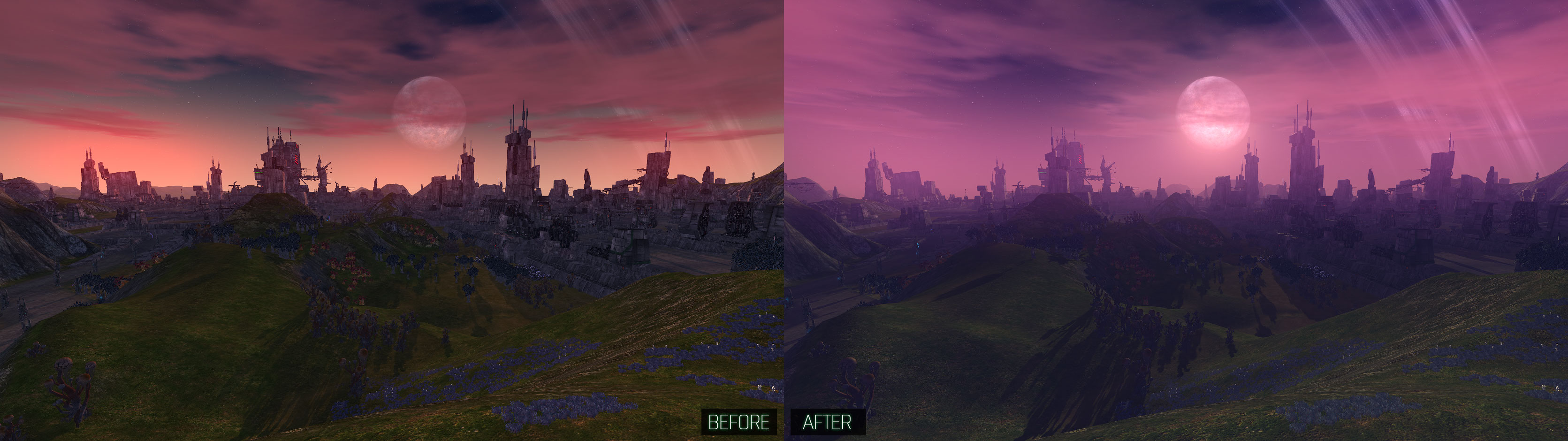
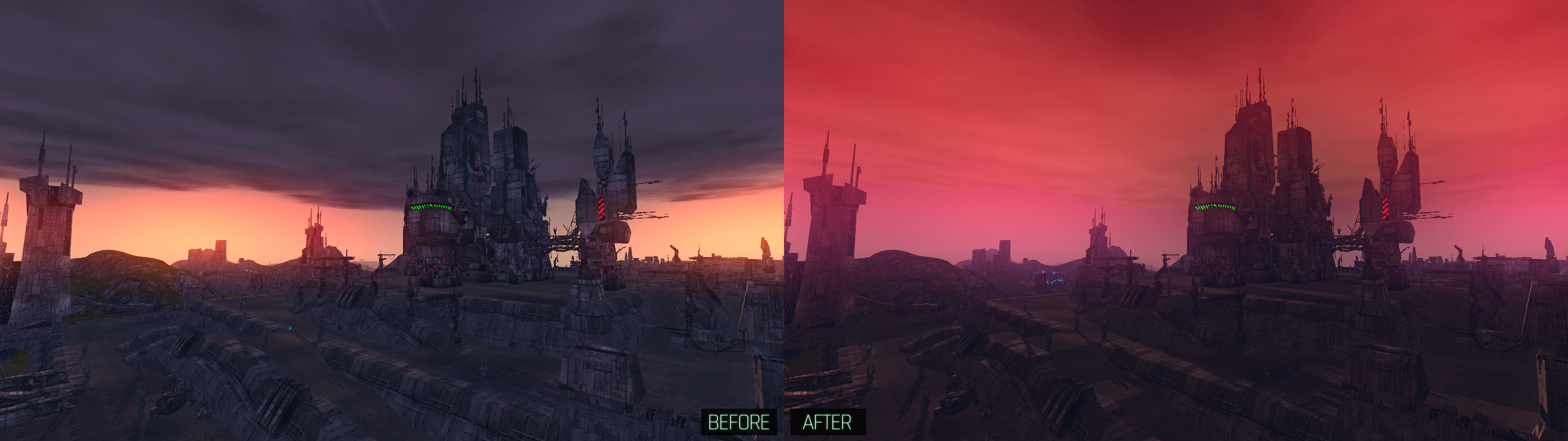
But now that DEV BoyC is working on the complete revamp of our terrain-engine, he could come up with a solution that allows for real time updating of terrain textures based on slope and elevation. This means that when you start to raise a mountain, the ground texture will gradually change from grassy to rocky, all in real time. Not to mention that we can scrap those old island texture masks too, and that means less memory usage, smaller patches, and a smaller datafile.

The terraforming process itself will happen with help of a terraforming module of course, which will use different kinds of charges, depending on what you want to achieve. The basic raise/lower charges are self-explanatory, these will simply pull up or push down the targeted area by a fixed height value. Then there is the leveling charge, which tries to pull the surrounding tiles to the targeted tile’s level, within a small radius. Finally we have the smoothing charge, which can turn sharp edges and spikes into smooth ground, and also works on a small radius.

Terraforming charge types and their effects

The terraforming module will also check for plants in the area, and will first try to kill them before modifying the ground. This however will be a very slow process (and a waste of terraforming charges), so plant bombs or “manual gardening” will still retain their importance.

Due to various position updating issues we had to make a rule which will not allow terraforming if anyone is within a 1-tile border of the terraformed tile or area (“safe area”). Unfortunately this rule (and some other factors) does not really make this kind of terraforming suitable for group efforts, and is only intended for smaller fixes or touch-ups here and there.

However we have plans for another, team terraforming feature. We’re still working out the details of this one, but the basic idea is that a player could use the same terraforming brushes like we devs can to create a kind of holographic terrain blueprint. Then, terraforming beacons need to be deployed inside that area, and a team of terraformers can start charging the beacons using special modules from outside the area. In effect, the terraforming beacons will start to “pull” the affected area towards the form of the blueprint.

There will be a few global limitations to terraforming, even on gamma islands. First and foremost, there will be a few predefined non-terraformable areas, which will generally mean the vicinity of fixed teleports. We don’t want anyone to get trapped on the other side, or allow to shut off complete islands from the rest of the world. Another important rule is that you won’t be able to modify the shoreline of islands. And lastly, there will be limits to how high or low you can dig, and the maximum steepness you can achieve.

In our next episode

Well, that’s pretty much all there is to the basics of terraforming. We’re still working on some of the details, and we’re of course eager to get some feedback from you as well. In the next part we’ll have a look at the basic rules of building structures and how you can connect them to each other.

Happy New Year everyone! We might have been a bit silent during the holidays, but now we’re back to developing with full force. In this blog I will talk about some of the upcoming features in January - we have quite a few new toys for your sandbox.

New player experience improvements

This one was promised for December, but didn’t quite make it, so we’re deploying it in our next patch, on Wednesday the 11th. The improvements consist of a brand new tutorial assignment line, which will now feature an initial general line, which unlocks a separate combat and industrial line. We’re also improving the level 0 assignments, which are meant to provide a stepping stone until you reach level 1s, or lose your first light robot and have to fall back to an Arkhe.

Improved NPC AI

Creating a perfect AI is no easy task, so we’re constantly experimenting with it in the hope to make our NPCs smarter than a jellyfish. This latest iteration will give them the ability to manage their own accumulator properly, and also make them more aware of line-of-sight issues. In practice this will mean that they won’t deplete their energy anymore by trying to shoot players hiding behind walls, and thus become easy prey for them. They also get a much improved pathfinding algorithm, so they will be less prone to getting stuck, and it will be even harder to shake them off. The changes will mostly affect higher ranked NPCs, as the lower ones are slow anyway or didn't have accumulator management issues.

Inter-island mobile teleports

These new deployable teleports will function just like the existing ones, the difference is that they can quickly move you and your squad to a fixed teleport tower on another island. They will have of course a higher price tag, and a distance limitation too, but if you need to quickly move troops to another island, they will probably come in very handy.

Deployed proximity probe

Proximity probes

These teleports would likely be a bit overpowered if there wouldn’t be a means to counter them, so to that end we’re introducing proximity probes. These probes can be deployed from your robot’s cargo to the terrain, and function a bit like remote security sensors. They will detect anyone coming near to them, and notify you with alerts on your world map and optionally via the event messaging system too, regardless where you are.

This system somewhat ties in to our upcoming territory control and player-built settlements (PBS) system, so it will be only usable within corporations, and with a limited number of assigned users per probe. Naturally you can also destroy enemy proximity probes, although they can only be detected from a very short distance. Last but not least, these probes are basically the first deployables that are fully persistent, meaning they will stay on the terrain forever, until they are destroyed.

Deployable walls

Also as an early herald of PBS, we’ll give you the possibility to build persistent walls for passive defense of your territory. The particularly interesting part of these walls is that they are using our existing plant-growth system: they pretty much work as if you would plant a noralgis-incubator. When deployed, they first start out as small flagstones, and the included tiny nanobots will slowly build them up to high columns, so they can block the way and provide cover.

Walls growing

Walls can be only deployed on beta islands outside a 1km distance from terminals and teleports to prevent unwanted pool closages, but other than that you’re pretty much free to build anything you want with them. (Somehow I feel I will regret saying this...)

Plasma bombs

Again, a new toy needs a fitting counter-toy too. Although you can tear down walls with your guns as well, it won’t be very efficient due to their relatively high hitpoints. So we thought it’s high time we brought in some WMDs.

Once deployed and activated, plasma bombs will unleash the biggest boom you’ve ever seen so far on Nia. Their main role is to wipe an area clean of walls and plants, but they will also deal substantial damage to anyone foolish enough to stand around when they go off. In theory it’s possible to use them in battle too, but their relatively long activation time provides for ample getaway time, and it’s pretty easy to shoot them down too, so utilization there might be a bit more tricky.

We are having a lot of fun with them on the devserver, so we made a (not too realistic) video too (warning: profanity inside).

So to summarize, the new assignments and the improved NPC AI will be a part of the patch on Wednesday. The proximity probe and the new teleport will come shortly after that, followed by the walls&bombs package, likely inside a two-week timeframe from now.

Meanwhile we’re finalizing the concept of the terraforming and player-built settlements system, so a blog about that will pop up soonish, too.

So, Intrusion 2.0 has been out for a little more than a week now and we’re happy to see the pew-pew it generates on the beta islands. Like every complex system it’s not perfect, so we’re performing small modifications based on your feedback over the coming weeks. We also intend to give both attackers and defenders a few additional strategic tools and features - more on this in a separate blog post soon.

Meanwhile, we’re working on the foundations of the player-built structures system, but we don’t want to leave you without new features and content for the rest of the year, so let’s have a look what we have in store for you in December.

The Scarab

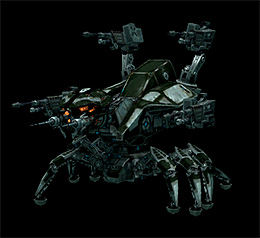
I know most of you are waiting for this, so I won’t tease you any longer. As announced in our last newsletter, a new freighter-type robot is about to make its entry into the world of Nia. Its name is Scarab, and it’s the first member of a new robot class we call gliders.

The common feature of gliders is that they are hovering above the ground, which means they have excellent slope capabilities, and resistance against demobilization. They are also relatively big, which in turn means they make excellent targets too... We have plans for heavy and light glider classes, both in combat and industrial roles as well.

Scarab concept art
Scarab - work in progress model

The Scarab specifically is a heavy industrial glider, designed to transport huge amounts of cargo, a whopping 720 units. The bad news is that in order to keep it levitating, it has to have a pretty thin framework and light armoring, so it will be quite vulnerable. It does have 2 universal chassis slots that you can fill with medium weapons too, but heavy escorts are recommended. For support modules you’ll have 4 head slots and 1 leg slot to play with.

As for required extensions, you will need some higher levels in Advanced robot control and Industrial robot control, as well as the new Glider control extension, specific to the new class.

While we plan to have an Mk2 version of it, like for all robots in the game, that one will be only introduced a bit later.

Syndicate Supplies

Have you ever wanted to do a suitable assignment but got turned off by the reward bullets that you don’t use anyway? I know I did.

At first we wanted to give you an option to select your reward items before you accept the assignment, but that felt kinda limiting as well. So we decided to give you complete freedom by adding some universal faction tokens as assignment rewards, which you can exchange for things you really need.

The place where you can do the exchange will be a new base facility called Syndicate Supplies (formerly known as EC-shop). At the start it will offer the well-known advanced ammo types (which have become a bit of a rarity by now) for assignment tokens, but later on we will also include many more items purchasable for Energy Credits (yeah it’s coming a long way), or a combination of currencies. Just to be absolutely clear, this is not a microtransaction store, it uses new ingame currencies which you can gather by various activities.

New robot animations

You saw what we did to the Arkhe, now our animators are close to wrapping up the next bigger package. The 3 light combat robots and the 3 light EW-robots will get the same treatment soon, and will be sporting much better looking walking and running animations.

Beginner assignment improvements

During the past months we have replaced all level 1-2-3 assignments with better and more interesting ones, but before we move on to level 4 and up, we have to take a step back and have a look at the start of the game.

While the general feedback on the 10-part tutorial assignment line has been mostly positive, it is starting to get a bit outdated. The plan is to split it into two branches, one combat and one industrial-oriented, and include some newly introduced objectives, like artifact scanning, distress beacons and manufacturing. Players will be able to complete both branches, one with a combat light bot reward at the end, and the other with an industrial one. Our intention is to give everyone the opportunity to decide which path they want to take (it can be both too!), and to show them all the activities they can do in the game.

We’re also revamping the level 0 assignments; we know they are a pretty bad grind between the end of the tutorial and the start of the level 1 assignments. They will also make sure that you have some more interesting objectives to do than killing drones over and over, if you accidentally lose your first tutorial light bot and have only an Arkhe available.

DEV Alf is also brewing some NPC spawn balancing changes and some new modules and new weapon ammo types using cycle time modification, but the details still a bit hazy, so more on those a bit later :)

Christmas is coming too, so we plan to have some smaller PvE events, and we're starting to pick up some strange artifact signals again, too. Nothing fancy though, we know most of you have better things to do at that time than sitting in front of a computer. Or do you?

Anyways, questions and comments are more than welcome, as always!

It’s been a while since we announced Intrusion 2.0 back in July, but we have used these months to fine-tune the original concept and turn it into reality. Today I’m happy to announce that the new system will be deployed in our anniversary patch, on the 1st of December.

If you’re unfamiliar with the concept of Intrusion 2.0, we recommended you read the previous blog about it, but I’ll try to cover all the important details here as well. The basic premise hasn’t changed; we still want it to be a system that reflects the main powerblocs on an island via outpost ownership, while making both owning an outpost and doing intrusions more worthwhile, and of course to get rid of the fixed event times and registrations. Some of the details have changed though, and we think for the better. Let’s have a look!

The basic mechanics

One of the most notable changes will be the lack of an event calendar, because the whole system will be pretty random for defenders and attackers alike. Taking part in an intrusion event will be a matter of being at the right place at the right time.

The events will still happen around Service Access Points (SAPs), with the same old SAP types. One notable difference compared to the SAPs you know now, is that they will be easier to complete, even with a relatively small squad. But the main difference in the new system is that only one SAP will open up at a time for an outpost, and you won’t know exactly which of the three SAPs it will be beforehand.

If you’re an attacker, and you see an open SAP, you simply start completing it. The system will immediately add your corporation to the list of attackers. If you can complete the SAP objective before it closes, you win the intrusion.

If you’re on the defender’s side, your only goal is to keep the attackers from completing the SAP until it closes again. Simple as that - you won’t even have to touch it. The maximum time limit until a SAP is open has been reduced to 1 hour; that’s the time you have to stick out.

An important sidenote: should the defenders start completing a SAP, technically they will also become “attackers”, and if they win the intrusion they will decrease the stability of their own outpost!

Intrusion times

SAPs will open up at random times at every outpost in 8-16 hour intervals. This means that when one intrusion finishes, the next SAP at the same outpost can open anywhere between 8 and 16 hours. This also means that the minimum time where you can be sure no SAP will open at the same outpost is 8 hours. This rule works independently for all outposts, so it is quite possible that there will be more than one intrusion happening in parallel.

There is no way of knowing which of the three SAPs will open, but there is still a way to know at what time it happens.

Captain, we have spies in our backyard!

You’ll be able to scan for intrusion times in the same manner you scan for artifacts. Your trained ninjas will have to get relatively close to the target outpost and use a new geoscanning ammo specifically designed to find out when then next SAP will open. The scan result will tell you the time, with some random inaccuracy depending on your geoscanning extensions, and the remaining time until the SAP opening. Naturally, outpost owners will only have to step out and do a scan to know the time of the next event, but they will also have to be on the lookout for spies trying to scan for it.

Outpost stability

As mentioned above, now there is only one SAP to complete or defend at a time, and you win that intrusion. Winning an intrusion does not mean that you become the owner of the outpost, though.

Since the new system is much more random than before, there has to be ample buffer space, to prevent you needing to stand guard around your SAPs 24/7. We know you have a real life too... most of you, anyway.

This is where outpost stability comes in.

Outpost stability is a number between 0 and 100, which represents how much a corporation “owns” that outpost. Intrusion events will dynamically modify this number up and down. When someone completes an intrusion, stability will go down. When the owners (and/or their allies) can keep anyone from completing an intrusion, stability will automatically go up. Remember that the defenders won’t even have to touch the SAP, so there is no restriction or rule who can be a defender - it’s all in the sandbox.

Different types of SAPs have different stability values, here’s how it looks like:

  • Passive hacking: 10 points
  • Active hacking: 15 points
  • Destruction: 15 points
  • Specimen processing: 20 points

These are the same when attacking or defending, so for example when you complete a Destruction SAP, outpost stability will go down by 15 points, and if you successfully defend a Passive hacking SAP, stability will increase by 10 points.

To make another example on the big picture, if you own an outpost with 100 stability, you have to lose about 7-8 intrusions in a row (7*15=105, depends on SAP types of course) to lose that outpost. This means around 3-5 days of minimum buffer time, depending on how much the gods of randomness favor you (ie. the 8-16 hour intervals).

Intrusion event log

Gaining ownership of an outpost

Every now and then an intrusion event will bring down outpost stability to 0. At this point the outpost will go into a contested state, where no one owns it. The next intrusion event will be decisive regarding ownership: whoever completes it will be the new owner of the outpost, starting with a stability of 5. Of course this can just as well be the old owner, in which case they manage to regain ownership again. No “claiming” an outpost for millions of NIC, no protection tokens; from then on the owner’s task is to keep the SAPs alive.

SAP loot

Typical loot from a high-stability outpost's SAP

To make it all a little more interesting, and to give you all more incentives to do intrusions, all SAPs will drop a loot container. They will do this regardless if you complete the intrusion, or if there is a timeout (a successful defense.) The catch is that they won’t be assigned to anyone, so if you want it, you’ll probably want to make sure that the area is clear from enemies when the time comes. Of course during tighter intrusion events it’s also possible that the losing team ninja-loots it and gets away with it.

The higher the outpost’s stability value, the more loot they will contain and the more chance they will have for higher level items. Loot also depends on the type of SAP and the outpost’s faction, and can contain decoders, CPU cortexes, lots of minerals, distress beacons or ammunition. (A little hint: a SAP loot of an outpost with 100% stability will always contain officer beacons!)

The benefits of owning an outpost

So far, pretty much the only notable benefit corporations had by owning an outpost was the fee paybacks from facilities. While this enabled them to use the high-level outpost facilities practically for free, there was no option which could help them shape their outpost to their liking, or generally look at it as their home.

Now, the fee paybacks will still be around, but the new system has much more in store for the potential outpost-keepers.

Outpost Access Control

Outpost controls

One of the main benefits of owning an outpost is the long-awaited option to close them down from unwanted enemies, aptly called Outpost Access Control. The feature simply consists of an on/off switch and a relations slider, which determines the minimum relation at which you let in other Agents. The slider is exactly the same like the one you use for setting your relations to anyone, so for example if you set access control to “Good”, it will only allow entry for members of a corporation for which you have set at least “Good” relation or higher. Access control will become available if your outpost reaches at least a stability of 50.

Auras

Auras are basically outpost-level NEXUS modules. They provide small but notable bonuses to the members of the owner corporation, and they do this on the whole island where the outpost is located. The more stability the outpost has, the more Auras will become available for you to activate, but only one at a time. Effects include bonuses to mining or harvesting amount, geoscanning accuracy, armor repair, accumulator recharge and detection&masking. At stability 100, complex auras become available which combine some of these bonuses.

There is one piece of bad news for those who plan world domination though: an Agent can only be affected by one Aura effect at a time. So if you plan to own more than one outpost on an island, you’ll have to make decisions when selecting your active Auras. To avoid switching them back and forth too quickly, changing Auras will also have a 24-hour cooldown.

Facility upgrades

Outpost facility upgrading

So far outpost facilities had fixed levels and there wasn’t much strategy involved, except for trying to get the outpost with the better facilities that suited your needs.

Now owners will be able to shape their outpost’s industrial profile, by upgrading facilities from level to level, even up to level 4!

Facility upgrading is also tied to outpost stability levels: at first, all facilities are only level 1. As the outpost gains stability, every 10 points you’ll be able to spend a facility upgrade. So if you manage to get it to 100, you’ll be able to upgrade altogether 10 facility levels, in any combination. This means for example that at stability 100 you can have two level 4 facilities and the remaining four on level 2 (2*3 points, plus 4*1 points). Or you can have five on level 3 (5*2 points), and one remains at level 1.

Naturally if the outpost’s stability gets lower, you will lose your upgraded levels, starting from the last one you upgraded (or simply deducted from the unspent upgrades, if you have any). Productions in progress will not be affected by this, only new processes will start with the reduced efficiencies.

This system brings in a whole new level of strategy: is refining more important for your corporation than anything else? You can upgrade to a level 4 refinery already at stability 30. Or are you sure that you’ll be able to bring it up much more than that and spread the levels evenly to help every aspect of your production? Or do you own two not-so-stable outposts on one island, so you upgrade reverse engineering here and the factory there, and transport the goods between them? All up to you; we’re really curious how you will use this system.

There is a catch to outpost modification, too: only upgrading is possible, there is no direct option for downgrading. You can take the risk of reducing the stability of your own outpost to free up that one upgrade point you need... as we said, it’s up to you.

Outpost owners on the map and the new context menu for outposts

Make your mark and let others know

We also wanted to make intrusions much more the center of attention, since they are currently the pinnacle of intercorporation warfare, shaping the political map of Nia day-by-day. Even if you are not into PvP, you probably want to know what’s going on around you.

In this regard, intrusion news was quite hidden so far; you couldn’t even poke your buddy to check the news and brag him about your latest win!

To this end we’re adding a new tab into the News window (right beside the list of “Most dangerous Agents”), which will list all the past intrusion events, complete with the owners, the winners, and outpost stability changes.

The world map will also have the option to show outpost owners, with their corporation logos neatly hovering above their outpost icon.

Outpost information with facility listing and custom public description

We also implemented the same information windows for terminals and outposts that robots and modules have too. These will also show the current owner and stability levels (the latter in a nice graph as well), and the facility levels at that specific outpost. This will also work for alpha outposts, so you won’t have to ask around about which one has the level 2 refinery anymore.

Lastly, owners of an outpost will be able to write a public description of their property, and this will also be visible for everyone who brings up the outpost’s information window. You can use it to advertise your facilities, taunt your enemies, advocate world peace, or whatever you like (well, within reason of course)!

In conclusion

Currently owned outposts will start from stability 5 (this also changed since the previous devblog) when the patch goes live on the 1st of December, but we’ll delay the start of the first intrusion events to Monday (5th), after the anniversary weekend, so you won’t have to worry about them while you’re taking part in the festivities.

*Phew* that’s all of it I think. There is no tl;dr version for this I’m afraid, but trust me, it’s a pretty straightforward system once you get the hang of it. I tried to cover everything, but I’m sure many of you will have questions, which we’ll be happy to answer in the comments below or on the forums!

New week, new patch - seems like we’re on a roll. As promised a month ago, we’ll deploy the spark change and extension system upgrade patch this Friday (10-28). If you haven’t read the previous blog about the topic, I’d recommend checking it out, because I won’t repeat everything there, but rather focus on the new stuff.

Sparks 2.0

Asintec industrial spark

Have you ever wondered what the tiny nanobots we call “sparks” look like? Well, now you’ll know :)

In order to give sparks a gameplay role, we converted them into passive module-like items, which provide small permanent bonuses and are interchangeable. The first pack of available sparks is already quite sizeable, with different types in terms of level, faction, specialization and price, but we intend to introduce new ones in the future too.

To get hold of a spark, however, you need proper authorization to use them (basically “unlock” them). This authorization process can either mean a one-time NIC payment, or reaching a certain level of relation with a corporation. Later on we’ll also introduce new sparks unlockable for Energy Credits (when that system rolls out), or a combination of these.

Sparkling sparks

Once you’re authorized to use a spark, you have to install it, which costs varying amounts of money. Unlike authorization, which you only have to do once, changing between sparks always has an installation cost, even if you change back to one that you already had installed. There is also a 1-hour integration period, during which you can’t install another spark. Standard sparks which you choose during character creation are all authorized from the start, so you’ll only have to pay a small installation fee if you want to change to another standard type.

Extension downgrading

Again, pardon me if I won’t repeat all the details and reasons about attribute removal and the new calculation method of extensions. Please see the previous devblog for reference.

In short, extension downgrading will be the ability to downgrade extension levels (duh), and to get back the EP and NIC you have spent on them. This feature is mainly intended for new players, to give them a chance to correct their mistakes while they are learning the game, so downgrading will only be available for 30 days after you create your first character. Since this is a new feature, though, we’re also providing all veteran players a 30-day grace period. This grace period starts from the patch on Friday.

There are a few limitations to downgrading:

Extension downgrading
  • It’s not possible to downgrade below your initial extensions.
  • It’s not possible to downgrade an extension level which is a prerequisite for another extension that you have.
  • There is a global freeze limit, which means if you go over it, you won’t be able to downgrade anymore (this also applies to old characters). This limit has been set between level 6/7, so if you have something on level 6, you'll still be able to downgrade it, but not level 7 and up. There will be a popup warning if you’re about to cross the freeze limit with an upgrade.
  • There will be a rolling limit which will only allow you to downgrade a sum of 5 levels of any extension in the last 12 hours. (We call these downgrade tokens, and they are account-based, just like available EP.)

As you can see on the screenshot, the downgrade button will tell you how much EP/NIC you would get back if you decide to do it. The lower part of the window has also been extended with more info about your spent EP and on downgrading.

Last chance to do an account reset

As announced in the previous blog, we’re saying farewell to the account reset feature in this patch. If you have any reason to perform an account reset, you can still do so until Friday! You can do it without any repercussions, since all the EP penalty will be reimbursed during the patch, regardless how many resets you did so far. This is also your only chance to get rid of an unwanted extension that you upgraded beyond the above mentioned freeze level of 6.

Closing

As much as we would like to, we can’t promise that we’ll have a patch every week now. These patches are merely a culmination of our development work during the past few months, so these are special times :) Of course, we’re doing our best to finish some features that are still in the works as soon as possible. November will be a very exciting month. Two words: intrusion and anniversary.